Closing the Battery Loop: Shredding Is Solved, Collection and Offtake Are Not
Shredding a battery pack into black mass is an industrial process now, in Europe and in the US. What is not solved sits on either side of it: packs that arrive charged and undocumented, and black mass that gets refined into intermediates nobody nearby is set up to buy. Stage by stage, what works, what does not, and the questions still open, from Automechanika, ICBR and ReCell in September 2026.

 United States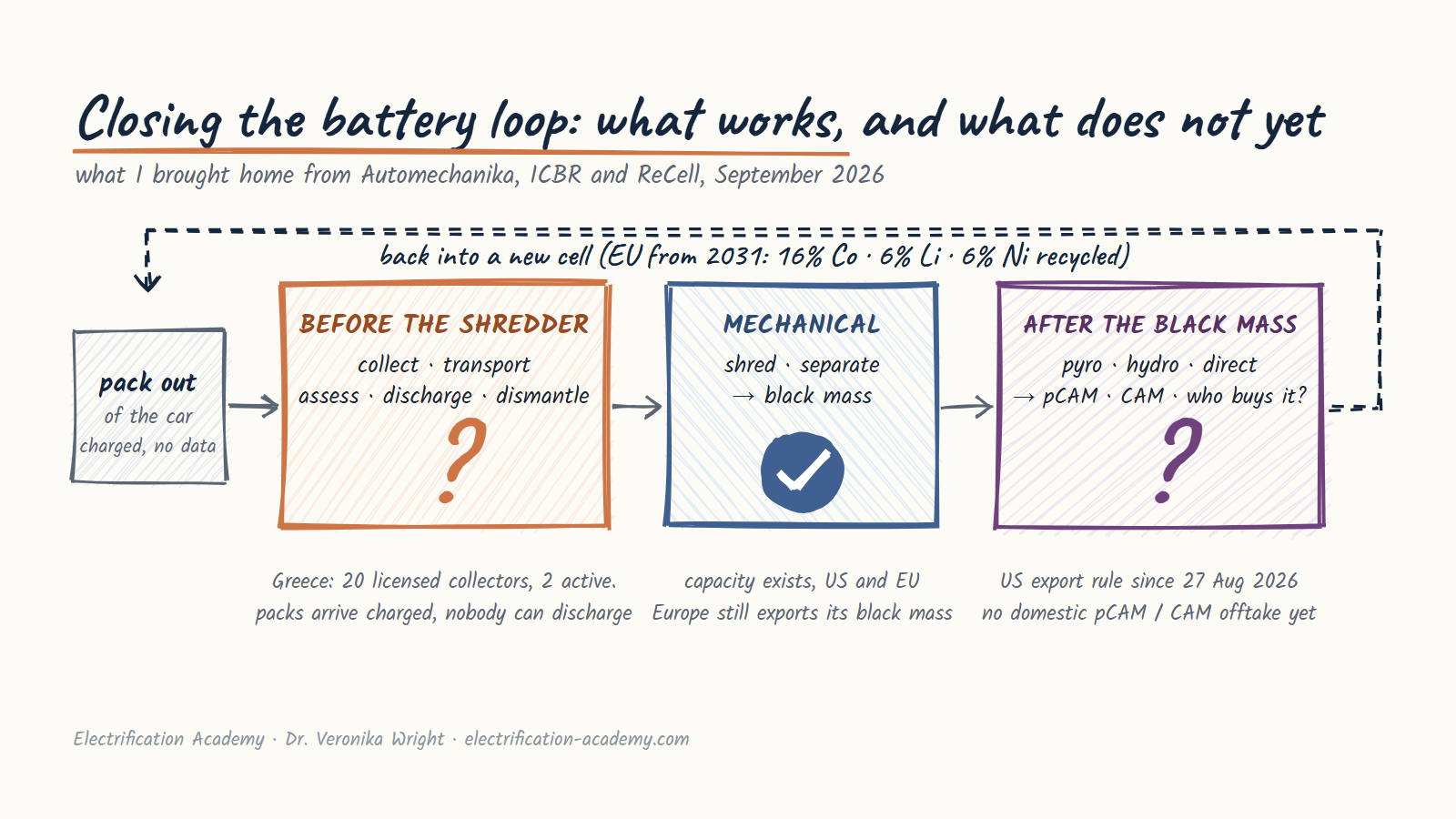
In September I went to three very different events. Automechanika in Frankfurt is the aftermarket world: workshops, parts distributors, repair and diagnostics. ICBR in Berlin brings Europe's battery recyclers together every year. The ReCell industry collaboration meeting at Argonne National Lab brings US recyclers, national labs, OEMs and startups into one room.
The audiences had little in common, but the conclusions were the same. The middle of the recycling chain works. Shredding to black mass is built out, on both sides of the Atlantic. What is not solved is everything before the shredder and everything after the black mass. Before: packs leave the vehicle charged, nobody local knows how to discharge them, and they get shipped anyway. After: black mass gets refined into intermediates that nobody on this continent is set up to buy.
Below I go through the chain stage by stage: what is working, what is not, and the questions the industry has not answered yet.
Get updates like this in your inbox. I send one every two weeks: what changed across the battery value chain and why it matters. Free, and you can unsubscribe any time.
Three rooms, one picture
Automechanika Frankfurt, 8 to 12 September. The aftermarket show. Think of it as the SEMA of Europe: workshops, parts distributors, remanufacturers, diagnostics companies. I gave a keynote, sat on the Pioneer Award jury and moderated a panel with Steven Chung of ReJoule and Patrick Reiter of ANDRITZ on the business hiding between the car and the shredder. The short version: an EV pack is not an engine. An engine never leaves the automotive industry. A battery can, and the aftermarket now decides whether a pack is an asset or waste.

ICBR Berlin, 9 to 11 September. The International Congress for Battery Recycling, in its 31st year and, as always, one of my favourite rooms: the European recyclers, the pre-treatment companies, the refiners, the regulators and the consortia that run the collection experiments. This year the talk was about the front end (collection, transport, discharge) and about black mass quality, in that order. I recorded the sessions I quote below. ICBR 2027 is already on our events page.

ReCell industry collaboration meeting, Argonne National Lab, 21 to 22 September. ReCell is the US Department of Energy's battery recycling research centre, run out of Argonne with Oak Ridge, NREL, Idaho National Lab and a long list of universities. Its mission, in its director's words: improve the economics of recycling, secure future supplies of critical materials and use less energy than making the materials from ore. Half of its portfolio is direct recycling. The meeting also hosted the winners of the DOE Lithium-Ion Battery Recycling Prize and, on the second afternoon, my own talk on the bottlenecks nobody owns.

1. The front end: collection, assessment, discharge and dismantling
Everything I heard in Berlin and at Argonne about the front of the chain comes down to one sentence. Packs come out of vehicles charged, damaged and undocumented, and the people who first touch them are the least prepared.
Most collectors stay away from EV batteries
At ICBR a European consortium presented RISBAT, a project on safe pre-treatment and second-life pathways for lithium-ion batteries inside producer responsibility organisations. Three PROs take part, from Greece, Portugal and Romania. Sortbat, which has collected and pre-treated EV and industrial batteries in Norway for ten years, and a robotics partner bring the process know-how. The research partners handle validation and technology transfer.
The starting point was practical: how do PROs in countries without a recycler organise the handling of lithium battery waste in a way that is safe, economically sustainable and compliant with the new EU battery regulation? The regulation raises the bar for them in three places: stronger requirements for collection and appropriate treatment, much greater emphasis on traceability, and a clear objective of keeping batteries and materials at the highest possible value for as long as possible through reuse, repurposing and high-quality recycling.
The mapping exercise produced the number I keep quoting. Greece has 20 licensed lithium battery collectors and 6 licensed secondary storage facilities. Two collectors and three storage sites actively handle EV batteries. The speakers gave these reasons:
- Fear. The real stories about fires keep operators away from high-voltage batteries.
- Low volumes. There are not enough end-of-life packs yet to lose anything by staying out.
- Charged packs. Batteries arrive with energy still in them, transport wants 30 to 40 percent state of charge, and most sites have neither the know-how nor the equipment to discharge.
- Gaps in the system. In most of these countries there is no recycler and not even a pre-treatment facility, only limited high-voltage training, damaged batteries that sit in storage for months because every battery design wants its own ADR container (a PRO cannot stock hundreds of thousands of euros of containers on the chance that the right one is needed), and cross-border shipments whose notification takes months of effort.
The infrastructure that exists today is the one tomorrow's volumes will land on, and it has to be trained and given a way to operate profitably.
We heard the same at ReCell. One of the DOE Lithium-Ion Battery Recycling Prize winners is building a discharger for salvage yards and car mechanics. Their description of what arrives today: large-format packs at up to 800 volts with 20, 30, 40 percent of their energy still inside, because the battery reached end of life for one bad module while the rest is fine. That is what makes the pack hazardous to recycle and risky to transport. Their first technical lesson was voltage rebound: a pack you took to zero comes back an hour later, so a discharger has to hold the voltage down, not just reach it once.

A different model: bring the expertise to the battery
Sortbat's answer is to move the work to the battery instead of moving the battery to the work. Assess the pack at the point where it is disconnected from the vehicle, with a tool that classifies it green, yellow or red for transport, decides the packaging and flags early whether it is a candidate for second life. Dismantle to module where it makes sense. Discharge on site. Packs at 30 to 40 percent state of charge go to second life. Everything else goes to 0 volts, and only those get shipped to the gate of the shredder or the furnace. In Greece with its islands, the reverse logistics have to be designed per island, which is exactly the kind of local adaptation the project was set up to test. The first real implementation is a regional venture in Greece, meant as a blueprint for the other two countries, and the project closes in two months.
One more thing from that session, on second life, which many recyclers walk out of the room over. The Sortbat speaker was careful: the market exists, its size is unknown, and it swings with the price of new batteries, which sets the floor. But in the first six months of this year they sold as much second-life material as in all of last year. So there is a market. How big and for how long, nobody knows.
Hydrovolt showed what happens without this. Norway put EVs on the road early, so the recycler in Fredrikstad sees the end of life before anyone else in Europe. They have taken in more than 20,000 packs of more than 400 different types, and because the OEMs carry little documentation with the battery, they reverse-engineer each type to find the best way to take it apart. Two stories from their talk stayed with the room. The first: 1,800 packs a trader had stored for years in poor condition, trying to sell them for second life and finding no buyer. When the municipality and the regulator became aware of the pile, someone with competence had to clean it up. Hydrovolt checked every single pack on site before it could be moved, and several were critical. The second: a photo a dismantler sent them a few weeks ago, a burnt battery packed together with other batteries into a 20-foot container, with the question "can you come and help us?" The dismantler did not know the risk they were taking. Hydrovolt now pays to train the dismantlers on safety checks and dangerous-goods packing, and said many packs simply disappear into the second-hand market. Their three asks: logistics solutions that dismantlers can actually use, harmonised rules for shipping batteries and battery waste across the EU, and basic handling knowledge at the dismantlers.

Discharge before shipping, or at the recycler?
This is the biggest open question of the three events, and the room did not settle it. The arguments as I heard them:
- For discharging early, at the collection point: safer transport, cheaper shipping, and local reuse decisions become possible because you have assessed the pack before it leaves.
- For discharging at the recycler: concentrated expertise and better equipment in one place, and some recyclers design their process to need no discharge at all. ABTC said at ReCell that its mechanical process was designed from the beginning to require neither electrical discharge nor physical disassembly.
I do not think there is one answer yet. It probably depends on chemistry, condition and distance. I know where I lean. Tell me where you do.
I saw more new discharge equipment at ICBR than at any show before. Cellavie is new on the platform with a regenerative pack discharger (peak efficiency of 96 percent) and a module discharger. If you need to discharge in Europe, talk to them. The stage page on discharging and dismantling has the comparison of resistive and regenerative systems and the transport regulation notes.
Dismantling: still manual
Nobody I spoke to expects fully automated pack dismantling soon. Hydrovolt started with the vision of automated dismantling and no longer believes in it for the near future: a first-generation pack that has done 100,000 kilometres has rusty screws and needs plan A, B, C and D, and with 400 types in the yard a robot programmed for one of them does not help. One of the DOE prize winners, Rose City Robotics, applies vision models and transformer-based motion planning to disassembly and said the bottleneck for AI here is not the algorithm but the data, which only operators have.
The research side is further along on what happens after the module comes out:
- A French research team at ICBR presented the pre-treatment side of a European project that ran from 2022 to this year with about ten million euros and more than fifteen partners: a cutting and extraction line that opens a deactivated EV module and pulls the jelly rolls out selectively, without shredding. The motivation is black mass purity. A module contains only 20 to 30 percent active material, and crushing it leaves a few percent of metallic and fluorinated impurities in the black mass that have to be removed downstream at a cost. Their pilot opened a Tesla module of 87 kilograms with more than a thousand cells and recovered 59 kilograms of jelly rolls, cleanly separated from 27 kilograms of casing, foam and other components. A BMW i3 module with twelve prismatic cells was easier: the gap between casing and cells means no material losses in the cut. Their conclusion slide summed up the state of play: stack extraction demonstrated at module level for prismatic, cylindrical and pouch modules; one prismatic module treated in 40 minutes today, under five minutes targeted for the end of 2027; black mass quality to be validated with Fraunhofer and TU Braunschweig in the EU-funded UPRAISE project in 2027 and 2028; and a full Tesla module with more than a thousand cells in under ten minutes by 2028. The advantages they claim over crushing: no mixing of module components with active material, so fewer impurities and lower purification cost for direct and hydrometallurgical recycling; no delamination of anode and cathode, so graphite and cathode separate at electrode level; and a plug-and-play step that fits in front of an existing crusher.

- Glimpse, another prize winner, does high-throughput CT scanning of cells for defects and named the gap honestly: CT works at the cell level, a full pack would need ten million dollars of equipment, so for recycling the realistic route is sampling a few cells from a known pack type.
- ReJoule brings a five-minute impedance test to where the batteries are. They are testing tens of thousands of recalled Chevrolet Volt packs for one of the largest second-life storage companies, sorting good from bad on site: fifty times faster than charge-discharge cycling, at a tenth of the energy, and without shipping the packs to a lab first. More on that in What really matters in battery state of health testing.
- Li Industries in Charlotte runs what it calls the largest smart battery sorting line in the Americas at 500 tonnes a year and plans to be at 12,000 tonnes by the end of 2027.
- NREL and Carnegie Mellon updated the 2015 second-use study: it is far cheaper to reuse a whole pack than modules than cells, because every unit you split has to be tested and qualified under UL 1974. LFP packs are the strongest candidates for second life on cycle life and low recycling value; NCA is usually only worth recycling.
My conclusion for the front end: we need a routine
- Assess packs early, where they come out of the vehicle.
- Take them apart to module level locally where that makes sense.
- Decide locally what gets reused and what gets recycled.
- Ship only what is truly meant for recycling, in a safe state.
That is where the value is kept, and where most of the risk is removed.
2. Mechanical processing: the part that works
This is the part nobody argued about, in either room. Shredding a pack into black mass is an industrial process now.
In the US, Tesla's recycling team said plainly that the country has a mature domestic mechanical processing capacity, with recyclers in many states able to take battery material and turn it into an enriched black mass. Blue Whale Materials, twelve years old, commissioned its Oklahoma facility in August 2025, finished the first phase of a DOE-funded expansion last month with a rotary kiln, and now has 20,000 metric tonnes a year of input capacity. Tesla itself has run its first recycling facility next to Gigafactory Nevada since the end of 2020 and has further operations in Texas. ReCell's pilot plant at Argonne, which we toured, makes a black mass its director believes is cleaner than anyone else's in the room, and he offered to prove it.
In Europe, Hydrovolt has run the Nordic region's largest plant since 2022, and one recycler at ICBR suggested some plants may even have been over-built for the cell-to-module-to-pack designs that cell-to-pack is now replacing. Every recycler in Berlin agreed on the sequence: the shredding side is fine, the refining side is not, and the difference shows up as black mass on ships to Asia.
3. The US black mass rule: a license, not a ban
On 30 July the President issued a determination under the Defense Production Act on wastes containing recoverable critical minerals. On 4 August the Bureau of Industry and Security at the Department of Commerce filed a temporary final rule, effective 27 August, running for one year, that requires US persons selling black mass from lithium-ion battery recycling (and tungsten waste and scrap) to allocate 100 percent of monthly sales to US persons unless BIS grants an adjustment or exception. A US person is an individual or company physically located in the United States, including a US subsidiary of a foreign parent, as long as the material stays in the country. Transfers to a parent or affiliate abroad are covered. Customs can detain material at export. There is a tolling carve-out for material that goes abroad for processing and comes back, a 90-day comment period, and a stated 14-day target for exception decisions.
At ReCell, Tyler Helps of Automotive Resource Company, who spent a decade in EV battery remanufacturing, shredding and the salvage marketplace, moderated a panel with Robert Chang, co-founder of Blue Whale Materials; Matt Cooper of Green Li-ion; David Wagger, chief scientist of the Recycled Materials Association; and the senior manager for recycling at Tesla. The main points:
- "A license, not a ban." Tyler said this is how officials describe it. In practice it is a ban you can apply to be exempted from.
- It was ready before the announcement. The presidential determination came out on a Thursday, and the draft rule that followed within seven days was not changed.
- What is covered: shredded lithium-ion material with a cathode, even if it is not technically black mass. Sales to a US subsidiary of a foreign parent count only if the material stays in the US.
- What is not covered: intact batteries, vehicles with batteries in them, unshredded production scrap, nickel-metal-hydride black mass, and refined products. Nobody on the panel could say at what point black mass counts as refined, for example after calcination. The customs codes were called flawed, and a sharper revision is expected after the comment period closes, perhaps in mid-November.
- Exceptions come quickly. Blue Whale stopped transactions on the day the rule came out. The next day Robert Chang's business partner, an attorney, wrote a seven-page letter with six reasons for an exception, addressing the spirit of the rule rather than its codes. Two weeks later they had it. He counts three or four other companies with exceptions, which is what keeps the industry moving.
- Little has changed so far. Blue Whale holds a DOE grant that already forbids selling to foreign entities of concern, and Tesla had been observing the same rules with its refiners; for both the negotiation is with Commerce over the exception.
The panel also named the risks:
- Material may leave in another form. If shredded material cannot be exported, whole packs and unshredded scrap may be shipped instead, which undercuts the one part of the domestic industry that is mature.
- Salvage values. Tyler said more than half of the electric vehicles at salvage auctions today are bought by non-US buyers and exported with the battery inside. Fewer bids on the battery as a part means a lower value for the vehicle at auction, on top of already weak used-EV valuations.
- Stuck owners. David Wagger, for the vehicle recyclers: if an EV becomes a negative-value proposition, dismantlers are not obliged to bid, and the last owner is stuck with the car. The near-term effect may be the opposite and not the worst: reuse suddenly looks more attractive than it did.
- Unsafe reuse abroad. Tesla's point: live cells sent to countries where "recycling" can mean harvesting cells for energy storage systems end up in systems built with counterfeit or mismatched cells, with a fire risk.
The most useful line came from Tesla's recycling manager: the rule is "definitely a stick," but it does not by itself create refining capacity, and it does not shorten the qualification of recycled material by a cell maker. Green Li-ion sees a tailwind ("a lot more phone calls," tolling opportunities, interest in licensing its process into regional hubs) and is expanding threefold by the second quarter of next year.

4. Refining and offtake: where the loop breaks
Say we keep black mass at home and refine it into battery-grade materials: precursor, cathode, lithium carbonate or hydroxide. Who buys it?
On the industry panel Ryan Melsert, CEO of American Battery Technology Company, was asked for the biggest barrier to recycling in the US and did not mention technology: "There's no demand center in North America for the outputs of a hydromet facility." There is a lot of push of material into recycling and not a lot of pull out of it. The precursor and cathode plants that would take a refiner's sulfates do not exist here or in the rest of North America, so even material kept domestic by the new rule gets shipped abroad and comes back inside cells. He added the rest of the list: no domestic graphite company to sell regenerated anode material to, close to zero electrolyte solvent and salt manufacturing.
Why does this not fix itself?
- Refineries are expensive. Matt Cooper put the price at about two billion dollars, and even then you would be behind.
- The economics are hard even with cheap feed. From the audience: suppose the rule holds and drives the domestic black mass price toward zero because the material is stranded. Green Li-ion said it is cash-flow positive today. Blue Whale said a very low price makes it very hard, and listed the hidden costs of refining in the US: sodium sulfate, sodium chloride, wastewater. Impure feed with 4 to 5 percent aluminium "we would lose a lot of money" on. LFP only works with a gate fee, and a gate fee means the collector pays to get rid of the material, which is a reason not to collect it.
- LFP uncertainty. Robert Chang has talked to several commercial refiners in Korea about coming to the US. Their answer is that traditional refining at commercial scale is too expensive to operate here, on top of the environmental burden, and then they ask: if LFP becomes the majority chemistry, why invest in an NMC refinery?
- Cell makers are cautious. Every intermediate has to be assay-mapped for impurities, and every impurity that goes in has to come out, which is more process steps and more cost. Precursor is not a generic product: each cell design has its own spec, so a merchant refiner taking mixed feeds has a long qualification road, months to years even inside a vertically integrated company. A consultant in the room seconded it from the buyer's side: the big cell makers will not buy from small suppliers under liability pressure; what is needed is a large, established cathode producer in the US.
- Pre-refined intermediates have no market either. Black mass at 20 to 30 percent metal content becomes mixed hydroxide precipitate at 40 to 50 percent, but Tesla's view was that domestic demand for MHP does not exist yet either, so most of it would still be exported, and the graphite and co-products still go to the established separation industry in Asia.
- Integrated players keep their output. Tesla's own refinery in Corpus Christi started production earlier this year and is ramping toward 20,000 tonnes a year of battery-grade lithium hydroxide, enough for about 30 gigawatt-hours, for Tesla's internal loop, not the open market.
- Policy consistency. Ryan Melsert's ask of government: five-to-ten-year projects cannot be planned against policy that changes every two to four years. The precursor companies he talks to all looked at building in the US and came back with two objections, no domestic feedstock and permitting timelines that sometimes end in no. David Wagger offered the CHIPS Act as the precedent worth studying, including the regulatory hoops that came with the money. Robert Chang's closing line was the bleakest of the two days: we have lost the war on critical minerals, we need a wedge, and there are no easy answers.
ABTC's own numbers are worth having. Their first plant outside Reno has run mechanical processing at commercial scale for three years, thousands of tonnes per quarter, and ran the last fiscal year at a profit on intermediates alone; the hydrometallurgical loop to battery-grade material runs at pilot scale. With BASF and the US Advanced Battery Consortium they made cathode precursor and cathode from recycled metals, built more than a hundred multi-layer pouch cells, tested them against cells made from virgin material, and found no measurable difference, which he called unsurprising because the recycled metals are made to the same specification. A second plant in the southeast, with a 150 million dollar DOE grant, will run five parallel lines specialised by form factor and chemistry.
Europe has the same gap with a different flavour. It has the demand side the US lacks, a regulation that forces recycled content and a cell industry that is at least planned, and it has the same missing middle: not enough refining capacity, so the black mass leaves. Hydrovolt exports all of its black mass to Korea, because "the willingness to pay for this in Korea is quite high," and a recycler losing a two-digit number of millions a year cannot subsidise European capacity into existence. European refining startups get trial orders from them. Their proposal: incentive schemes that make European buyers pay competitive prices.
Nordic Salt Cycle's take at ICBR was the most interesting answer I heard to that. Their thesis is that the accepted refining architectures, direct hydrometallurgy and pyro-plus-hydro, both suffer from the complexity that arrives with the black mass: the fluoride, the aluminium, the copper, the moisture, all of which vary bag by bag and drive the reagent consumption and the economics downstream. Pyro removes the complexity before the hydro circuit, but needs a smelter above a thousand degrees. Their process does the same job in molten alkali hydroxide salt at 450 to 600 degrees Celsius: stir the black mass in, and the material partitions. A nickel-cobalt-copper metal powder you lift out with a magnet, washable from 90 to 92 percent purity up to 95, 97 or 99 percent depending on what the downstream refiner or alloy producer needs. A technical-grade lithium carbonate at around 95 percent purity and 80 percent recovery. A salt phase that takes the fluoride, water, aluminium and, for LFP feeds, the phosphorus. And a graphite phase with the iron. Their commercial choice is the part I liked: they deliberately avoid competing with Asian buyers for premium black mass and target the difficult material, mixed with consumer electronics, off-spec, heavily penalised, hard to export, because that is where the problem is and where the flexibility on payables lives. Low opex and low capex allow a tolling model where the partner keeps the metal value. The pilot is at a Stena Recycling site in Denmark, around 10 tonnes a year for the first campaign, then a hardware upgrade to 50, then 1,000-tonne modules for co-location at a black mass producer's site.
In short: without pull from cell makers, domestic refining capacity will not be built, and without that capacity the loop stays open.
5. Direct recycling and new process routes
Direct recycling keeps the cathode's crystal structure intact and repairs it, instead of dissolving it into metal salts and resynthesising it. The argument is economic: a cathode's price is raw materials plus manufacturing, and if you do not have to make the cathode again you keep the manufacturing investment and gain a lot of room for the process steps you do need. It is about half of ReCell's research portfolio. When ReCell started, one US company worked on direct recycling. Now it is four. The centre has more than a dozen cooperative research agreements with industry, more than 30 patents, more than 70 publications, six R&D 100 awards including one this year, and has started licensing.

The pilot plant. In a renovated 20,000 square foot high bay at Argonne, the front end is a combined shredder, washer and dryer. Cells are shredded under nitrogen (the shred size and shape are designed for separation, small squares rather than strips), washed in a rotary drum to recover the LiPF6 electrolyte salt, dried in a tray dryer that condenses the wash solution for reuse. The shreds are sieved to collect fine anode and cathode powder that already delaminated; aspirated in a zigzag air column to blow out the separator and pouch material; and passed over a rare-earth magnetic roll, twice, because the cathode powder is magnetic enough to stick while the anode is not. The cathode fraction goes through a rotary kiln to burn off the binder and carbon black; the anode fraction is water-washed to delaminate the copper. What comes off the cathode line is a powder with very low aluminium and copper content. Minimum batch for an industry trial: around 20 kilograms, better 100, because every stage loses a little.
Results I wrote down.
- Direct-recycled LFP: binder removal has to run under inert gas for LFP (air oxidises it to an iron oxide phase). The inert route delivered about 142 mAh/g against a 154 mAh/g commercial baseline, with the gap explained by leftover carbon. A hybrid route, dissolving part of the feedstock and resynthesising it with added lithium-deficient LFP by spray drying, gave a phase-pure material at the commercial baseline with controllable carbon coating.
- Upcycling: taking ten- to twenty-year-old low-nickel NMC and converting it to a higher-nickel composition (622 to 811) by coating with a nickel-rich hydroxide and diffusing it in, either keeping the secondary particle or splitting it into single crystals. Capacity rises to the upcycled composition's value and in the single-crystal case beats the baseline. This won an R&D 100 award last month.
- NREL's redox relithiation: a redox mediator shuttles lithium from a lithium source into the cathode powder at as low as 60 degrees Celsius, regardless of how much lithium was lost to the SEI or to the state of charge at shredding. End-of-life NMC111 and NMC622 came back to 100 percent of the expected capacity in full cells. LFP is next.
- Hybrid electrodes: a blend of 80 percent pristine and 20 percent recycled cathode was indistinguishable from pristine in rate tests, at a cost premium of about 5 to 10 percent, mostly processing. NREL's reason for the work: the EU will require recycled content, and pristine supply may not meet demand anyway.
- Black mass purification for direct recycling: acid leaching removes the copper and aluminium flakes but destroys the crystal structure, so NREL went alkaline instead. Aluminium comes out completely; copper is the open problem, with a design of experiments running on particle size and morphology.
- Oak Ridge: green, commercially available solvents (ethylene glycol, water with additives) that peel electrode films off the current collectors in seconds, which also recovers the copper foil intact; ionic liquids that separate anode graphite from cathode by density; LFP upgraded to LMFP by adding manganese for 15 to 20 percent more energy density; and electrochemical separation of manganese and cobalt out of leached black mass by moving pH and potential. The Oak Ridge presenter's own words on maturity: direct recycling is "still kind of infancy stages" and needs sustained work to become commercially viable.
- Economics: EverBatt, ReCell's public techno-economic model, puts the break-even for LFP manufacturing scrap at about 8 dollars per kilogram of LFP against 10 for end-of-life feeds. Li Industries already produces directly recycled LFP cathode material at its 500-tonne line in Charlotte.
Recovering the rest of the cell. Materials that are usually lost today: electrolyte extraction with condensable dimethyl ether recovers up to 96 percent of the electrolyte components, with the LiPF6 degradation product LiPO2F2 as the target salt because it is a saleable additive, though it is metastable and the separation is unfinished (their side discovery: washing and refilling a cell that had faded to 90 percent restored 99.7 percent of its capacity, an oil change for a battery). PVDF binder recovered selectively by extraction and put back into cells that perform like pristine-binder cells. Recovered graphite from Ace Green's industrial pilot line came in at about 200 mAh/g, half of spec, with poor rate capability; acid leaching, annealing under hydrogen and a coating brought it to pristine performance and in some cases better fast-charge capability than a state-of-the-art commercial graphite, with the open problem being cost, because a thousand degrees for hours is too much energy for a low-value material. And old flake graphite is being spheroidised by milling, with machine learning to search the milling parameters, so it can meet today's fast-charge demands.

Where it works today. Direct recycling works when you know what you have. One chemistry, fully discharged, ideally manufacturing scrap. That decision is made before the shredder, not after, which is why the front end of this chain decides what the back end can do, and why sorting, assessment and discharge are not side topics of recycling but its precondition.
6. Closing the loop: mandates and first proof points
Two forces could create the pull that refining needs.
Regulation. From 18 August 2031 batteries placed on the EU market must contain minimum recycled content: 16 percent cobalt, 6 percent lithium, 6 percent nickel (and 85 percent lead). From 2036: 26 percent cobalt, 12 percent lithium, 15 percent nickel. At ICBR the regulation was also discussed as pushing more duties onto the take-back schemes: traceability, and keeping batteries at their highest value, reuse before recycling. Cross-border shipping approvals still take months, and one speaker called the notification paperwork the nightmare of every PRO. The caveat I share with the researchers: the targets can only be met if there is cathode production capacity to put the material into, which brings us back to the demand-centre problem.
Customers. Matt Cooper's last word on the ReCell panel was the honest one: the customer has to drive the initiative. Some OEMs have said ten percent, the EU is mandating it. If it stays fine to put virgin material in every time, recycling never becomes part of the ecosystem.
A real proof point, this month. GM and Cirba Solutions completed a closed-loop pilot. Eighty end-of-life GM packs were processed to black mass at Cirba's Ohio facility, converted into more than 12 tonnes of cathode active material with 100 percent recycled nickel, cobalt and manganese, made into cells by Ultium Cells, and assembled into packs at Factory ZERO and Spring Hill. Those cells are in Cadillac Lyriq, Vistiq and Escalade IQ vehicles and in the Silverado EV and Sierra EV, already delivered to customers. The recycled cells performed comparably to virgin-material cells in testing. It is a completed pilot, not series production. GM has shown that recycled material can meet the specification. The open question is whether it can pay at scale. electrive
And one in Europe. Porsche and Aachen-based cylib have announced cells made with cathode material using recovered lithium, nickel, cobalt and manganese from Porsche batteries. Porsche says those cells are still being tested in prototype vehicles; it is considering future use in series production and expects material recovered from batteries collected through German Porsche Centres to be available for new cell production from 2028. Porsche Newsroom
My takeaways
- The front end is the biggest lever and the least solved. Early assessment, local discharge and dismantling, and reuse-or-recycle decisions will decide safety, cost and how much value we keep.
- Mechanical capacity is not the bottleneck. Where black mass goes next is.
- Export controls keep material in the country, but they do not create buyers. Refining capacity needs demand from cell makers.
- Direct recycling is real for production scrap and still years away for mixed end-of-life packs.
- Mandates and OEM programmes like GM's could create that demand. Watch whether more automakers follow.
New to recycling? Start here: Assessment and Transportation · Incoming Inspection and Storage · Discharging and Dismantling · Mechanical Recycling · Material Recovery.
Recycling partners on the platform: Cellavie (new) · Great Lakes Recycling · URT · ANDRITZ · MSE Filterpressen · Oscorp Energy · ReJoule · Envaion.
Battery Manufacturing
Recycled cathode material only becomes a cell after qualification, and Tesla's recycling team put a number on that at ReCell: months to years, even inside a vertically integrated company, because every impurity has to be mapped and every cell design has its own spec. I see the same thing in my consulting work right now with a new PFAS-free binder: 500 prismatic cells built, promising data, and still a long road to a cell maker saying yes. Recycled content is a qualification problem before it is a chemistry problem, and it is one of the reasons I brought the binder project to the ReCell room: the qualification and validation process for a new material is the same problem the recyclers have, and we could work on it together.
On the assembly side, Mahmoud Hermes wrote the Battery Pack Assembly Toolkit for the platform. Mahmoud has spent close to twenty years industrialising products across automotive, battery and aerospace: nine production lines built in five countries, high-voltage battery manufacturing taken from prototype to certified series production, and on the aviation side an accountable-manager role under EASA Part 21. Today he is developing an 800 V battery system for Swisspod's hyperloop program. The toolkit takes cylindrical-cell pack assembly stage by stage, from cell acceptance and sorting to pack testing and commissioning, and comes with an equipment and partner shortlist and a design calculator. If you are specifying a module and pack line, EnerLink Systems' prismatic module and pack assembly line is on the platform with the full station breakdown. And for the cell side, the Equipment Procurement and Acceptance Toolkit for electrode coating and drying is the companion piece.
Battery Safety
Two stationary storage fires in California in five days. Moss Landing burned again on 18 September, twenty months after the fire that destroyed more than half of its 100,000 batteries; around 1,500 damaged batteries were still on site, and residents got another shelter-in-place order, lifted the same afternoon. On 22 September a battery storage unit at the Metropolitan Water District plant in La Verne exploded and burned, with about 500 homes evacuated, two schools closed and one person injured; the evacuation orders were still in place the next day while crews cooled a neighbouring unit that kept heating up. CBS San Francisco · CBS Los Angeles
Both are reminders of why we are building Battery Ready with NextCycle Michigan: open-access, practical safety knowledge for everyone who has to remove, move, store and assess a battery for the first time. In Michigan we talked to local business owners, scrap yards and workshops about what they actually need, and the list came back as emergency response, handling damaged batteries, risk assessment, vehicle extraction, packaging and transport, storage layout for a first operation. That is what is being built now, as a public section of the platform, released piece by piece.
Two people joined the Electrification Academy expert network this month for exactly this: Patrick Durham, a mechanical engineer with twenty years in automotive R&D on EV battery structures, safety specifications and failure analysis, and twenty years as a fire captain in Michigan, who sits on the UL Fire Safety Research Institute's Batteries and EV panel and founded StacheD Training, and Neža Lupšina, who has worked on thermal runaway, propagation, safety validation, failure analysis and system-level risk assessment across more than 120 battery projects in EV, stationary storage and industrial applications. A lot of the practical lessons in Battery Ready come from filming days at Great Lakes Recycling in Michigan, watching their team take EV and hybrid packs apart (their lessons are in 12 Key Learnings on How to Recycle EV Batteries), and at Prime Manufacturing in Detroit. If you want to be part of Battery Ready, sign up here.

New on the platform since the Mid-Year Update
- Cellavie: battery pack and module dischargers, France.
- Oscorp Energy: autonomous battery sorting system, AI and robotics for the incoming-inspection stage.
- Patrick Durham and Neža Lupšina: battery fire safety and battery risk assessment, expert network.
- Two guides with templates: the Battery Pack Assembly Toolkit and the Equipment Procurement and Acceptance Toolkit for electrode coating and drying.
- For members: log in to download every guide and template, save workflows and products to your dashboard, and search the Knowledge Hub by full text.
- Where to meet us next: The Battery Show North America in Detroit (week of 12 October) and Battery Recycling Expo North America in Atlanta (28 to 29 October). All events
Still open
Discharge before shipping, or at the recycler? Which part of this loop is yours, and what is stuck there right now? If I got something wrong, or you see it differently, please write to me. I read every one, and what comes up most is what I dig into next issue.
The questions already coming in through the platform show where the gaps are. Does wet shredding need an alkaline solution, or is water enough, and how much vapour does it really generate? Who verifies the exact chemistry of a module when the downstream mechanical recycler asks and the price depends on it? Soon these questions will have a home of their own: a members' space on the platform where you ask, and the answers come from people who have done it. If you have not yet, sign up here to make sure you get the invitation when it is live.
Stay Electrified,
Veronika
Get updates like this in your inbox. I send one every two weeks: what changed across the battery value chain and why it matters. Free, and you can unsubscribe any time.
About the author

Related Products & Solutions

Battery Pack Discharger RE-GEN 90


Oscorp Autonomous Battery Sorting System


Battery Module Scanner BattScan050M


EV & Hybrid Battery Dismantling & Recycling Services
