Hidden Business Opportunities in the EV Battery Aftermarket
Around 1.2 million EV battery packs will reach the aftermarket worldwide in 2030, and about 14 million by 2040. Every one of them has to be removed, moved, stored, assessed, discharged and dismantled before a recycler ever sees it, and nobody fully owns those steps yet. That is where the business is: the chemistry, the design and the real state of health of a pack decide whether it is repaired, remanufactured, repurposed for energy storage or recycled, and whoever can establish that early keeps the value.

 United States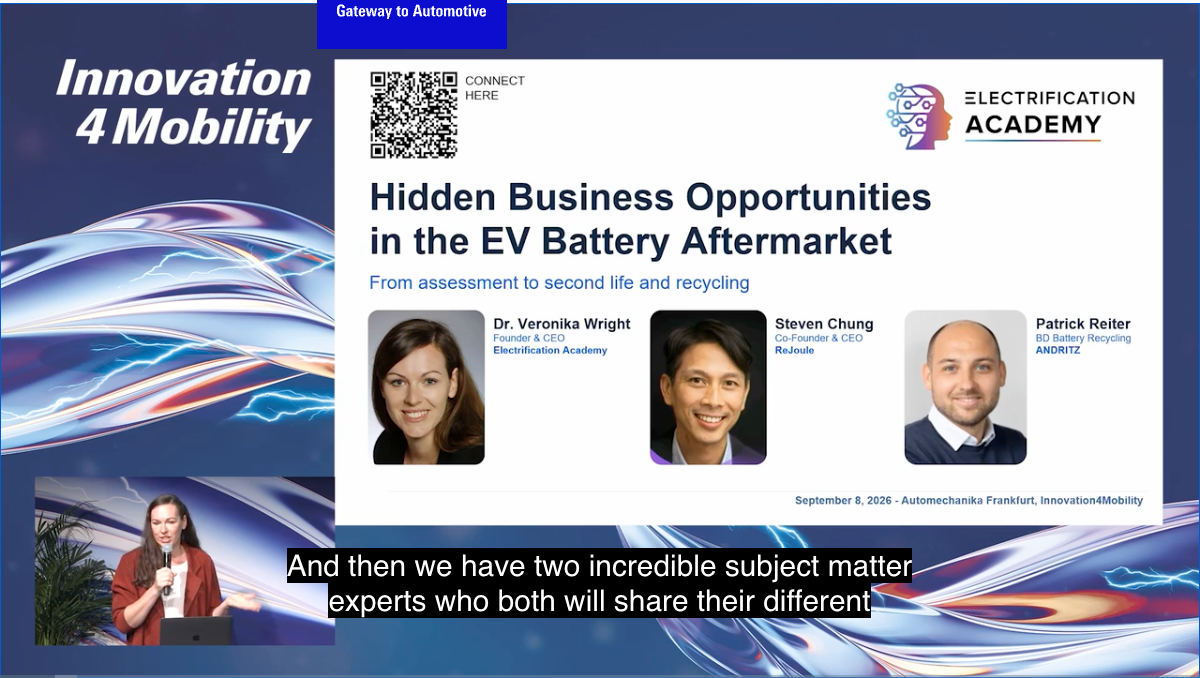
For a hundred years the aftermarket answered one question about a vehicle at the end of its life: is it worth repairing? With an electric vehicle that question moves from the car to its battery, and it changes shape. A pack that leaves a vehicle is not automatically scrap, and it is not automatically an asset. Somebody has to decide which it is, and today that decision is made with less information, by fewer qualified people, than at any other point in the battery's life.
This article is about that decision: the four routes a pack can take, the curve that sets its remaining value, the six steps between the vehicle and the recycler that nobody fully owns yet, and what chemistry, pack design and regulation do to the economics. It grew out of the panel I moderated at Automechanika Frankfurt in September 2026 with Steven Chung, co-founder and CEO of ReJoule, and Patrick Reiter, Sales and Business Development Manager for Battery Recycling at ANDRITZ, and out of the presentation I gave to open it.
Watch the full panel recording
4 battery journeys through the aftermarket
Four things can happen to a battery once it leaves a vehicle.
- Repair. One module out, one back in. Same pack, same car. This is the world of independent workshops, franchised dealers and mobile EV specialists.
- Remanufacture. Every module out, the pack rebuilt to specification and returned to a vehicle. Parts distributors and core traders, OEM remanufacturing plants and independent remanufacturers work here.
- Repurpose. The same battery, a completely new job: stationary energy storage, behind-the-meter systems for commercial and industrial sites, smaller electric vehicles. Dismantlers and salvage operators feed this route, second-life integrators build it, and energy companies and data centres buy it.
- Recycle. No pack any more, just material: lithium, nickel, cobalt, copper, aluminium. Dismantlers and treatment sites, pre-treatment plants, recyclers and chemical refiners.
The first two keep the battery in a vehicle. The last two do not, and the third takes it out of the automotive industry altogether. That is the part with no precedent. No other major component of a car has ever had a second customer waiting outside the industry, and this customer is not small. The energy sector wants these packs, and it wants them before they are worn out. Steven Chung said it in one sentence: the energy industry wants your ID.4 battery when you are done with it.

The volumes are coming. Roughly 1.2 million packs will reach the aftermarket worldwide in 2030 and around 14 million by 2040 [1], most of them in China today [2], with Europe's share growing fast. Every one of those packs comes back to somebody: a workshop, a yard, a dealership, a treatment facility. And every one of them has to be routed.
The battery life curve: why state of health sets the value
Everything downstream depends on one curve: battery capacity over time, usually expressed as state of health (SOH). The convention in automotive is that a battery's first life ends somewhere between 70 and 80 percent of its original capacity [3]. The battery does not know that. It keeps working, and it keeps working usefully, down to roughly 30 percent, which is where stationary storage stops making sense and recycling begins. The automotive industry stops looking long before the battery stops working.

After fifteen years in this industry I can tell you that we still do not have a clean understanding of how that curve behaves for every chemistry and every use profile. Steven Chung and his team work with General Motors, Nissan, Renault Group and one of the largest second-life companies in the world, and he brought three observations from testing packs that have been in the field.
- EV batteries are lasting longer than anyone expected. The fear that a traction battery would fade like a phone battery after five to eight years has not materialised, and several studies now point the other way.
- Cells inside a pack degrade at different rates. Every cell follows its own version of the curve. The spread between them is called imbalance, and in ReJoule's experience it is the biggest reason packs come out of vehicles for repair or second life.
- The state-of-health number reported by the battery management system is not always trustworthy. It is reliable in the first years of a vehicle's life. After that, one number cannot describe a pack made of many cells and components that are all ageing differently.
Add to that: there is no common definition of state of health, warranties are often written around mileage rather than around the battery, and the point where a pack is truly finished (capacity and power too low, internal resistance too high) is greyer still. So the number that decides the route is the hardest number to get.
Steven showed the room two packs, both labelled "bad". After testing, one was perfectly recoverable for its original application. The other showed a real fire risk if it had been used again. You cannot tell by looking. The methods range from full charge and discharge cycles (accurate, but hours per pack and a lot of power) to pulse tests that read internal resistance and electrochemical impedance spectroscopy, which ReJoule uses for a rapid state-of-health estimate. The methods are explained in What really matters in Battery State of Health (SoH) Testing?
Get updates like this in your inbox. I send one every two weeks: what changed across the battery value chain and why it matters. Free, and you can unsubscribe any time.
6 battery handling steps nobody owns yet
The two ends of the battery aftermarket are easy to describe.
On the left, a vehicle with the battery still in it. We know it holds roughly 75 to 100 kWh and weighs 400 to 600 kg. We usually do not know its state. It can leave the vehicle in five ways: an in-warranty replacement, an upgrade replacement, a test or R&D vehicle, a write-off after an accident, or a genuine end-of-life battery. Who gets access to the pack, and therefore where it goes, depends heavily on which of those five it was.
On the right, the recycler, who receives the battery as a pack, a module or a cell. Inside an NMC pack there are roughly 180 kg of minerals. With today's processes, about 90 kg come back as battery-grade material that can go into new cells. The EU Battery Regulation sets the targets: 90 percent recovery of cobalt, copper, nickel and lead by the end of 2027 and 95 percent by the end of 2031, and for lithium 50 percent by 2027 rising to 80 percent by 2031 [4].
Between those two ends sit six steps.

- Remove. Lifting a high-voltage pack out of a vehicle safely, with the right people, tools and protective equipment.
- Move. Transport is expensive and heavily regulated. Whether a pack is classed as usable, as waste or as defective changes the legal shipping format. Steven told the story of a shipment of about twenty packs that looked fine on paper: several arrived heavily dented from an accident and one batch was leaking, and nobody in the logistics chain had caught it. The supplier had to send people to dismantle the packs on site and repack the cell groups into drums before they could be moved to a recycler. We ship batteries we know nothing about all over the world today, and that has to change.
- Store. Packs wait, sometimes for years, for a decision. Storage needs space, fire safety and a way to keep track of what is in it.
- Assess. The hardest step. Whoever pulled the pack may have run some tests, but that information does not travel with the battery. The next owner has to test again, and the result of that test decides whether the pack stays in automotive or leaves it.
- Discharge. Bringing the pack to a safe state of charge for transport, or to zero volts before dismantling or shredding.
- Dismantle. Opening the pack to module or cell level. For many designs this is still eight to ten hours of manual work per pack [5].
None of this is clearly anyone's job yet. That is the opportunity, and it is also why Patrick Reiter's first point on stage mattered so much: people think recycling starts when a battery arrives at the plant. It does not. Decisions made much earlier define what the plant receives. The same pack at 100 percent versus 30 percent state of health returns different quantities of material. And a whole pack thrown into a shredder produces a very different process, and a much dirtier black mass, than a pack dismantled to module level with everything removable taken out first. Dismantling and discharging in the aftermarket directly affect recycling efficiency.
Repurpose or recycle? 3 things that decide a battery's route
Three things decide where a pack goes: what it is made of, what condition it is in, and what somebody downstream can do with it.
Battery chemistry: LFP, NMC and NCA
If you want to be part of any discussion about high-voltage batteries you have to know three abbreviations. LFP, lithium iron phosphate: cheaper, safer, very long life, and mostly iron, which is worth very little to a recycler. NMC, nickel manganese cobalt, and NCA, nickel cobalt aluminium: higher energy density, and full of the materials a recycler will pay for.
A paper published in Applied Energy in 2026 (Cobb, Ramirez-Meyers, Michalek and colleagues) [6] asked what a repurposer and a recycler could each afford to pay for the same used pack. The repurposer's ceiling is the storage value of the remaining life, minus testing, certification, integration and yield losses. The recycler's ceiling is the recoverable material value, minus recycling and processing costs. The result depends on chemistry first. For LFP, repurposing generally wins. For NCA, recycling generally wins. For NMC it is a case-by-case decision that depends on state of health and how hard the second-life application will work the battery.

Patrick's view from the recycling side was direct: NMC is worth more than LFP because of the materials it contains, but LFP has to be recycled too, and a recycler cannot say yes to one and no to the other. It has to adapt. What it should not do is recycle the two together, which means somebody has to identify the chemistry first, and that cannot be done by looking at the pack.
Scale matters as much as chemistry. Battery Design reported a case from a US salvage yard this summer [7]: a working Tesla pack priced at 1,200 dollars as a used spare drew a single recycling quote, of minus 1,800 dollars, because hazardous-goods logistics for one pack outweighed the metal value. At bulk scale the same material has positive value. For a single workshop or small dismantler, scale changes the sign of the number, not just its size.
Pack design: what can be opened and what cannot
The pack's construction decides what is physically possible. A modular pack with separable modules and fasteners can be repaired: swap a module, keep the pack. A cell-to-pack design, where cells are bonded directly into the housing, removes most module-level repair. A cell-to-chassis design, where the cells are structural to the body, effectively cannot be disassembled at all.
I showed two examples on stage. A Tesla-style pack that is glued and foam-filled cannot be opened or repaired, and it is hard even to cut it down to fit a shredder. A Hyundai platform has a lid that opens and closes, modules that can be swapped and in some cases access down to cell level. Even where a pack can be opened, modules are not interchangeable building blocks. Configuration, state of charge, cables, sensors, battery management system and software all have to match, and finding a used module of the right type at a similar state of health is a parts problem of its own [8].
Patrick was candid about the tension. From the recycling side, standardised cells and modules would be ideal, but every OEM has invested heavily in its batteries (he called the battery the new combustion engine), and what is best for the car is not always best for recycling. His answer is more education and more direct dialogue with the OEMs.
Battery repair in practice: lessons from China
A guest from a Chinese repair business gave the room the most concrete picture of what repair looks like at volume. By his account, EVs were about 60 percent of new car sales in China in the first half of this year, and repair comes first in his company. Their workflow: lift the vehicle, remove the pack, open it (they now prefer a cold room at about minus 40 degrees to break the adhesive rather than chemical methods that harm workers), find the few failed cells with a detection tool, replace them, re-balance the pack and replace the liquid cooling plate. For packs with cylindrical cells that cannot be repaired, they build remanufactured replacement packs with a different cell format that still communicates with the car. Very few companies in Europe or the United States have that level of hands-on experience yet.
EU Battery Regulation: what changes for the aftermarket in 2027
Two pieces of European regulation change who can make the asset-or-waste decision, and with what information.
Since August 2024, the EU Battery Regulation requires state-of-health parameters to be held in the battery management system and made accessible to the owner, explicitly so that residual value and second-life suitability can be evaluated [4]. From 18 February 2027, EV batteries carry a digital battery passport, accessible by QR code throughout the battery's life, with chemistry and composition, origin of raw materials and state of health. From the same date, EV batteries must be removable and replaceable by qualified professionals, not only by the OEM [4]. Taken together, data access, removability and parts instructions amount to a de facto right to repair [8].

Two caveats. First, timing. Packs built to these rules will not reach the aftermarket in volume until around 2035 [8]. The batteries arriving at workshops and yards in the next few years were built without a passport, and the aftermarket will have to find out what they are the hard way. Second, the End-of-Life Vehicles Regulation, agreed in 2026, adds something arguably more consequential for this audience: cores are no longer treated as waste, and member states must incentivise reuse and remanufacturing [8]. That changes the legal status of the part itself.
On the question of standardisation, the two panelists landed close to each other. Steven: we will never have every automaker building the same pack in the same factory, so transparency, knowing the chemistry, the voltage and the cell configuration as early as possible, will do more than anything else. Patrick pointed to the EU Battery Regulation, which beyond its recovery targets forces exactly that transparency. Which brings the OEMs into the picture: the manufacturer holds the data on the vehicle, and battery management systems each need their own software to read cell voltages, voltage spread and diagnostic codes. Every piece of that information an OEM shares with an independent garage sets up everything downstream.
Black mass and refining: why the battery loop is not closed yet
The loop is not closed today, on either continent. Refining capacity in Europe is new, so most black mass still goes to Asia, where the facilities exist and black mass trades as a commodity. Europe exports around 80 percent of its black mass [9], and since March 2025 the EU classifies black mass as hazardous waste [9][10], which restricts where it can be shipped without creating the refineries that would use it at home. What is missing locally is the materials companies that supply cell makers, and the refiners that turn black mass into what those materials companies need. Steven's warning applies to the whole chain: the economics have to work at every step, from collection to transport to refining, or the closed loop kills itself.
Patrick pointed to a trend among ANDRITZ customers that shows how the industry is adapting: recyclers forming joint ventures with cell manufacturers, because in the first years production scrap is the dominant feedstock, and the regulation obliges manufacturers to put recycled content into their next generation of cells. Recycling has the advantage of looking into the past to see what is coming, and what is coming first is factory scrap and hybrid packs, not the big EV volumes.
For the full chain from discharge to black mass and refining, see Closing the Battery Loop: Shredding Is Solved, Collection and Offtake Are Not and the Battery Recycling & Reuse workflow.
Who handles EV batteries, and the training they need
Every one of the six steps needs people who know what they are doing. Diagnostics, shipping, handling and dismantling all require knowledge, certifications, the right equipment and the right protective equipment, and most of the businesses that will receive these packs have never handled one. Electrification Academy is building a free training programme for exactly this audience: workshops and employees who lift, move, package and dismantle a pack for the first time. You can register interest here.
Steven's message to the aftermarket: vehicles already move through your network, and the people in that network hold many of the keys to the value in retiring packs.
2 panel takeaways: battery data and the value chain
I closed the session by asking both panelists what the room should remember.
Steven went back to information. A battery that comes with no information is considered riskier by any buyer. The more you can diagnose and pass on, the lower the risk and the more willing a buyer is to pay, whether the pack is headed for recycling, second life or remanufacturing.
Patrick came back to where he started: recycling does not begin at the facility. As he put it, we do not have a recycling problem, we have a value chain problem. For him the hidden business in the aftermarket is everything before recycling: transport, logistics, diagnostics and storage. There are good ideas and good companies out there, but none of it is established yet.
What this means for workshops, dismantlers, parts traders and recyclers
- If you run a workshop: the first pack that comes in will be a repair or a removal, not a recycling job. Invest in high-voltage qualification and in a way to read the pack's condition before anyone decides its route.
- If you dismantle or run a treatment facility: there is a buyer for a pack you pull today, and the more you know about its condition before it ships, the more value survives. Discharge locally where you can. Keep chemistries apart.
- If you trade parts or cores: the ELV rules move cores out of the waste category. Remanufactured packs and graded modules become a product line, and the grading is the product.
- If you recycle: what arrives at your gate was decided upstream. Every step you can influence before the shredder, from assessment to dismantling, shows up in your yield.
A retired pack is not scrap, and it is not automatically an asset. Assessment decides, the assessment does not yet travel with the battery, and the six steps in between are where the business is. ReJoule and ANDRITZ are in the portfolio below, and the training programme for workshops is open for registration.
Get updates like this in your inbox. I send one every two weeks: what changed across the battery value chain and why it matters. Free, and you can unsubscribe any time.
About the author

References
- International Energy Agency and European Patent Office. Battery Circularity: Innovation trends for a future source of critical materials. 29 April 2026.
- Kothari, V., Wang, K., Kumar, P., Xu, S., Li, S., Shah, K. Retired EV Batteries Can Play a Vital Role in Making Clean Energy More Affordable and Accessible. World Resources Institute, 16 June 2026 (citing BloombergNEF).
- S, V., Che, H.S., Selvaraj, J., Tey, K.S., Shareef, H., Errouissi, R. Repurposing electric vehicle batteries: State of art and challenges from repurposer perspective. Renewable and Sustainable Energy Reviews 213, 115439, 2025.
- European Union. Regulation (EU) 2023/1542 concerning batteries and waste batteries. Official Journal of the European Union, 28 July 2023.
- Scott, S., Islam, Z., Allen, J., et al. Designing lithium-ion batteries for recycle: The role of adhesives. Next Energy 1(2), 100023, 2023.
- Cobb, A., Ramirez-Meyers, K., Michalek, J., Swaminathan, S., Gasper, P., Polzin, B., Smith, K. Electric-vehicle battery second-life and recycling pathways: How economics depend on chemistry, processing, and application. Applied Energy 414, 127809, 2026.
- Taylor, N. What's the Value of an Old Battery Pack? Battery Design, 22 July 2026.
- Chung, S. (ReJoule). Repairability & Regulation. Presentation, ETI Conference Europe 2026.
- Logan, S. Power up: How EU-Africa cooperation can drive Europe's battery recycling future. European Council on Foreign Relations, 10 August 2026.
- Resource Media. EU classifies black mass as hazardous waste in updated list. 7 March 2025.
Related Products & Solutions

Battery Module Scanner BattScan050M


ANDRITZ Battery Recycling Solution


URT Lithium-Ion-Battery Recycling Plant


EV & Hybrid Battery Dismantling & Recycling Services
