Lithium-Ion Battery Safety Training for Frontline Workers
More large-format batteries are coming over the next decade, and each one passes through many hands: built by one company, shipped by another, taken apart by a third. Many of those hands are new to batteries. The law ties training to specific tasks. What comes first, knowing what a battery is, why it is dangerous and when to stop, is taught almost nowhere. That is the gap we are closing with Battery Ready: free orientation modules, built with battery safety experts and with the lessons learned in field operations, which we are collecting now.

 United States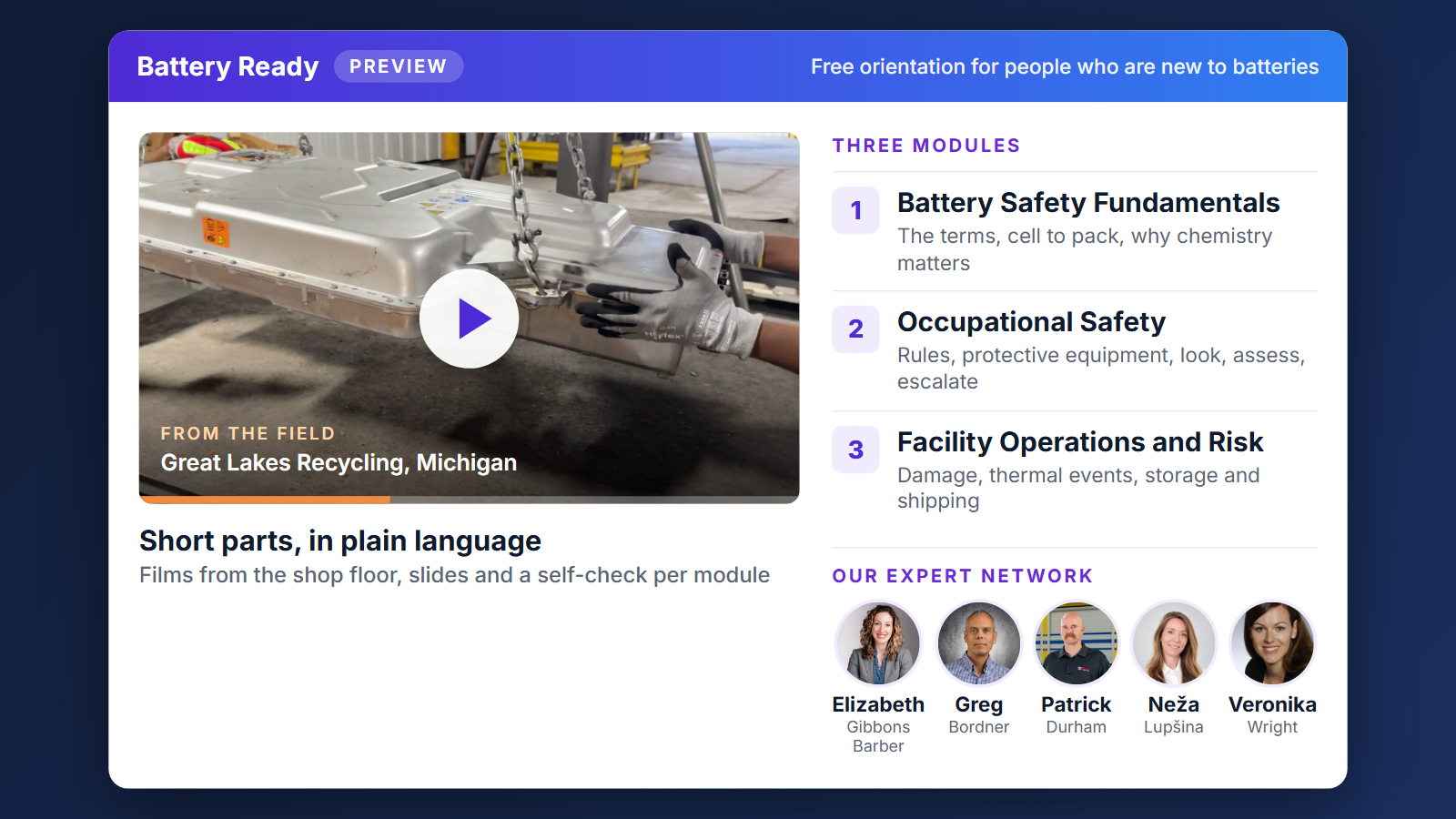
If you work with batteries, or you lead people who do, you have probably asked this question: what training is actually needed? I hear it from recyclers, from cell and pack plants, and from workshops and salvage yards that are just starting to get electric vehicles back. The honest answer has two parts. There is training the law requires, tied to specific tasks. And there is something that comes before it, which almost nobody offers.
This article covers both. It also comes with an invitation: on Thursday, November 5 we show the first version of Battery Ready, our free orientation for frontline workers, to a small group. And with a request, because we want your lessons learned in it.
Battery Ready soft launch: Thursday, November 5, 10:30 am US Central Time. 45 minutes, online, free. Sign up and we send you the meeting link.

"Plan on having the fire": 5 battery fire rules from a fire captain
I recently talked to Patrick Durham. Patrick is a mechanical engineer who worked on battery structures for electric vehicles, and he is a fire captain in Michigan. So he knows how a pack is designed, and he is the one who shows up when it fails.
What he sees in facilities just opens your eyes. Not everybody who works with batteries understands batteries. People store them in a way that makes sense to them: large quantities together, on racks, sometimes in a building with no suppression system at all. And when something does catch fire, employees rush in and start pulling trays of batteries out, and put themselves right into the hazard.
At one site he responded to, he asked the team what their plan was for a failure. The answer: "We didn't expect to have a fire."
So this is what he tells every customer: "Plan on having the fire, and make sure you have a plan in place if there is a fire." In practice:
- Write the plan for your own building. An emergency action plan is required by OSHA, but write it for your site, not from a template. He has seen plans for a site in Michigan with a section on hurricanes.
- Invite your local fire department in. Not the inspectors, the firefighters who would actually respond. Walk them through and play the what-ifs.
- Tell the dispatcher it is a battery. Then the crew puts the breathing gear on before they walk in.
- Teach your people to get away. His rule: if it's in thermal runaway, you run away.
- Don't trust the quiet. When a cell has failed, the worry is the cells next to it, which can catch fire later.
What a fire can cost a plant is in Equipment Fire Protection: The $100M Lesson the Battery Industry Keeps Learning.
Where employees need battery safety training: our Michigan survey
Recyclers and dismantlers, cell and pack plants, workshops and salvage yards, haulers and warehouses: in every one of these places there is a first day for somebody. And there will be many more first days: around 1.2 million EV battery packs will reach the aftermarket worldwide in 2030, and about 14 million by 2040 (the numbers and their sources).
What a new person rarely gets is the step before any task training: what a battery is, why it is dangerous, what a damaged one looks like, and when to stop and call somebody.
We asked. In spring 2026 we surveyed auto recyclers, fire services, a battery recycler and a battery response center in Michigan about where their employees need battery safety training.

92 percent named emergency response to thermal events and leaks, 77 percent handling damaged batteries, and 69 percent assessing crashed or damaged units. Most of them are early in this: 69 percent had five years of EV experience or less. And asked for the biggest barrier, more than half named training, trainers or knowledge. This is a small survey, not a study, but it matches what we heard in our interviews across Michigan this year.
3 lithium-ion battery misconceptions we keep hearing
Then there is the language. Here are three sentences that our experts hear over and over again. I am not assuming that you believe them. I point them out because we keep hearing them, and each one can lead to severe safety issues:
- "It's LFP, so it's not lithium-ion." LFP stands for lithium iron phosphate. That is the type of cathode, and the battery is still a lithium-ion battery.
- "It's discharged, so there is no voltage." A pack that is discharged to 0 percent state of charge is not at zero volts. It can still carry more than 400 volts.
- "It looks fine, so it is fine." At Automechanika, Steven Chung of ReJoule showed two packs that were both labelled "bad". After testing, one could go back into its original application. The other would have been a real fire risk. You cannot tell by looking. How that is tested is in What really matters in Battery State of Health (SoH) Testing?
In Patrick's words: "A lot of times the employees don't understand the hazards of batteries, and that's where you can get significant injuries."
Battery Ready: free battery safety orientation for new employees
Battery Ready is our answer to that gap: orientation modules for frontline workers, free of access, built with the people who do this work. We announced the project in June. It is led by Empower to Comply, with Electrification Academy as the education platform and VMX International as the battery recycling pilot partner, and it runs through NextCycle Michigan.

Who it is for. People who are new to batteries or newly assigned to them, in recycling, manufacturing, logistics and the aftermarket. And the people around them: the team lead, the safety manager, the HR person who brings new people in and needs something to send them through first.
What the modules cover. Three modules, each made of short parts. They are multimedia: films from shop floors, and next to them slides, best practices and the lessons learned at recyclers and other sites.
- Battery Safety Fundamentals: the terms you will hear, cell, module and pack, why chemistry matters, and how a battery moves from manufacturing to recycling.
- Occupational Safety: why the rules and procedures exist, why protective equipment differs by task, and how to look at a battery before it is handled: look, assess, escalate.
- Facility Operations and Risk: how to recognize a damaged, defective or recalled battery and the signs of a thermal event, what is regulated when batteries are stored and shipped, and which training different tasks may require.
What people get out of it. After each module there are a few questions to check yourself. The goal is simple: recognize what is in front of you, and know when to stop and tell somebody.
What it is not. It is orientation, not the training the law requires. In the words of the series: "Completing this series does not certify, qualify, or authorize anyone to perform any task involving batteries, including handling, packaging, shipping, dismantling, or responding to a damaged or defective battery. It does not replace employer-specific safety programs or satisfy any regulatory training requirement." Orientation comes first. The training the job requires comes after.
What it costs, and how to start. Nothing: it was built with grant funding, so that companies that cannot afford outside training are not left out. VMX International tests the modules with their own team first. On November 5 we show them to a small group, and after that they open on Electrification Academy, with a free account.
Battery safety training rules: OSHA, DOT and EPA at a glance
Orientation is the first step. The training that follows is tied to tasks, and it comes from more than one place, because the same battery can be a workplace hazard, a shipment, and a waste. This summary is based on the work of Elizabeth Gibbons Barber of Empower to Comply, who leads the content of Battery Ready. It uses U.S. federal rules as examples and is not legal advice.
- Worker safety is the field of OSHA and of state programs such as MIOSHA in Michigan. Examples are training in electrical safety-related work practices for work on or near exposed energized parts (29 CFR 1910.332) and training on the emergency action plan (29 CFR 1910.38).
- Transportation is the field of the U.S. Department of Transportation. Packing, marking, labeling, shipping papers and loading are regulated tasks that come with hazmat employee training (49 CFR 172.704).
- Waste is the field of EPA and of state agencies such as EGLE in Michigan. Batteries headed for disposal or recycling fall under waste rules, including training for universal waste handlers (40 CFR Part 273). A battery headed for reuse or repair may not be a waste at all.
- Emergency response has its own training for response teams, known as HAZWOPER (29 CFR 1910.120).
Which of these apply depends on the tasks at a site, and the employer determines and provides the training each job requires. The third module of Battery Ready gives an overview of this.
The battery safety experts and partners behind Battery Ready
This is not one person's view of battery safety. The content is led by Elizabeth Gibbons Barber of Empower to Comply, who worked on dangerous goods transportation at GM. With her: Greg Bordner, 32 years at Toyota, most recently as senior hazmat engineer for North America, Patrick Durham, mechanical engineer and fire captain (his expert page), Neža Lupšina, a chemist and battery safety consultant with more than 120 battery projects (her expert page), and me.
We didn't want this to come from a desk. So we took the camera to Great Lakes Recycling and to Prime Energy in Troy, both in Michigan, and more filming is happening this week.

And we are not doing this alone. The safety-focused partners of Electrification Academy each bring in what they are good at:
- Ansell: protective equipment for hands, eyes and body. The right glove and the right suit are the last barrier between a person and a battery. Ansell has just joined us.
- Envaion: a certified transport box for damaged lithium-ion batteries. If a battery fails on the road, the box is built to hold back fire and gas.
- Aesir: battery transportation and collection. Moving a battery is a regulated job, and it takes the right packaging, the right papers and trained people.
- ReJoule: a scanner that reads the state of health of a module without opening it. You know what you have before you store it, ship it or use it again.
With more companies in this field we are just finalizing the start. All of them are in Products and Solutions.
Your battery safety lessons belong in here
Battery Ready only works if it carries the lessons of many companies, not just the ones we happened to visit. So this is the part where I ask you for something.
Every company that handles batteries has learned something the hard way. A near miss. A rule you introduced after an incident. A simple trick a new person would never think of. If you share it, the next team does not have to learn it the same way. And your name and your company stand next to it: in the modules under "From the field", on the Battery Ready page, and in my newsletter.
This is what I mean. Three lessons from the floor at Great Lakes Recycling:
- Everything is charged. The team lead used to label the discharged batteries. Then he saw what a "discharged" label does: people take it easy. So now every battery is treated as fully charged, with full protective equipment.
- No metal straps on a battery pallet. Metal conducts. One band that touches two contacts, and you have completed the circuit.
- A place outside for the load you don't trust. If a load looks like trouble, it goes into a shipping container outside the building. In his words: "We lose just a container. We don't lose the whole warehouse."
Three ways to contribute, from five minutes to one day:
- Send one lesson. Two or three sentences are enough. What do you wish somebody had told your team on day one with batteries?
- Send a photo or a short clip from your floor. How you store, how you label, what hangs on your wall. A phone is fine.
- Have us over. We come with a camera for a day, like we did at Great Lakes Recycling, and your team explains how they work, in their own words.

You decide whether your name and your company appear. Our safety experts look at every contribution before it goes in, and nothing is published without your OK. Write to hello@electrification-academy.com.
Battery Ready soft launch on November 5: see it first
On Thursday, November 5 at 10:30 am US Central Time we show Battery Ready to a small group before it goes public: 45 minutes, online.
Come if you lead a team that works with batteries, if you are responsible for safety or for bringing new people in, if you work with batteries yourself, or if you want to contribute. And bring a colleague from the floor if you can. They are who we built it for, and they will tell us if we got it right.
Battery Ready soft launch: Thursday, November 5, 10:30 am US Central Time. 45 minutes, online, free. Sign up and we send you the meeting link.
This program is supported by the Michigan Department of Environment, Great Lakes, and Energy as part of the NextCycle Michigan initiative. Battery Ready provides educational awareness content and is not a substitute for hands-on training, certified instruction, or site-specific safety procedures.
Get updates like this in your inbox. I send one every two weeks: what changed across the battery value chain and why it matters. Free, and you can unsubscribe any time.
About the author

Related Products & Solutions

Battery Transportation Box VIO-10 Pro

Aesir Battery Logistics & Transportation Service


EV & Hybrid Battery Dismantling & Recycling Services


Battery Module Scanner BattScan050M
