Stage 1 of 4 · Part of Battery Module Manufacturing
Battery Cell Preparation

Individual battery cells are inspected, cleaned, and tested to ensure consistency and compatibility before module assembly. This stage may also include loading cells into fixtures, surface preparation, application of adhesives or thermal interface materials (TIM).

Cell preparation is the initial stage in battery module manufacturing. It involves taking individual cells as received from the supplier and getting them ready for assembly into a module. This includes processes like loading cells onto the production line, sorting them based on specific electrical characteristics to ensure uniformity within a module, cleaning cell surfaces and applying bonding adhesives or thermal interface materials (TIMs) if required by the module design. Each step is important for the subsequent quality, performance and safety of the finished battery module. It ensures that only compliant and properly prepared cells proceed to the mechanical and electrical assembly stages.
- IN
- Individual battery cells (prismatic, cylindrical, pouch)
- Cell packaging (trays, boxes)
- Adhesives
- Thermal interface materials (TIM)
- OUT
- Cleaned and potentially bonded cells, ready for module assembly
- TECH
EA Partner Solutions: EnerLink Systems LLC
1.1 Loading, Inspection & Sorting
- IN
- Battery cells in supplier packaging (trays, bulk containers)
- OUT
- Individual cells correctly oriented on the production line
- Sorted cells physically segregated into different bins or output for cell sorted
Cell loading is the first step in cell preparation, where individual cells are removed from their shipping containers (e.g., trays, boxes) and carefully introduced onto the automated production line or into specific fixtures. This process demands gentle handling to prevent any mechanical damage to the cells, such as scratches, dents, or stress on terminals, especially for delicate pouch cells. Modern lines often use robotic arms with specialized grippers and vision systems for precise and efficient loading.
The cell sorting process includes measurements of Open Circuit Voltage (OCV) and Internal Resistance (ACIR or DCIR), and sometimes capacity or weight. The sorting machine uses these measurements to grade each cell according to defined ranges. These measurements ensure that cells with very similar properties are grouped together for assembly into the same module. In other words, cells are automatically grouped or "binned" with others that have very similar performance characteristics.
Field challenges
Defining optimal sorting criteria for module performance
Determining the most effective sorting parameters (e.g., capacity, IR, OCV, or combinations) and the precise tolerance ranges (bin limits) for each grade is complex. This requires a deep understanding of how initial cell-to-cell variations affect the long-term performance, safety, and lifespan of the assembled module, demanding a careful balance between maximizing cell yield and ensuring high module quality.
Ensuring electrical measurement accuracy and consistency
A primary challenge is guaranteeing that all electrical measurements—especially internal resistance (IR) and open-circuit voltage (OCV)—are highly accurate, repeatable, and stable for every cell. Factors like contact quality between probes and cell terminals, temperature fluctuations during measurement (as cell properties are temperature-sensitive), and the time allowed for OCV to settle can all significantly impact measurement reliability, making meaningful sorting difficult if not precisely controlled.
How to achieve high-speed, accurate, and data-rich handling for diverse cells
A significant operational challenge is achieving high-speed cell handling and processing (e.g., during loading and sorting) to meet ambitious production targets, while simultaneously ensuring absolute precision in cell placement, orientation, and electrical contacting across a variety of diverse cell formats (cylindrical, prismatic, pouch) and terminal designs. This requires versatile mechanisms that make reliable electrical contact without causing any cell damage. Compounding this, these high-throughput operations generate vast amounts of measurement data for every individual cell, necessitating powerful and integrated data systems for effective storage, real-time analysis, and complete traceability to inform quality control and prevent downstream assembly issues or polarity errors.
Handling diverse cell formats and supplier packaging:
A key challenge is developing loading mechanisms that can reliably and gently handle the full spectrum of cell formats—including cylindrical, prismatic cells, and more flexible pouch cells. The system must operate without causing any physical damage such as scratches, dents, punctures, or undue mechanical stress, any of which could compromise cell integrity and safety. Furthermore, production lines must be versatile enough to accommodate the different types of packaging (e.g., plastic trays, cardboard boxes, with cells in varying orientations) used by diverse cell suppliers. This packaging variability can significantly complicate the design and operation of automated unpacking and loading systems, often requiring highly flexible grippers, advanced vision systems for recognition and guidance, or even periods of manual intervention to manage non-standard inputs.
1.2 Cell Cleaning
- IN
- Individual battery cells
- Plasma cleaner
- OUT
- Battery cells with clean and often chemically activated surfaces
Plasma cleaning is an advanced surface treatment process used in cell preparation. Its main job is to meticulously clean specific areas of battery cells – usually the electrical terminals before welding, or surfaces where adhesives will be applied. The process uses plasma, which is a highly energized gas, to remove microscopic contaminants like oils, organic residues, thin oxide layers, or dust. This creates an ultra-clean and often activated surface, which is essential for making strong, reliable electrical connections (welds) or for ensuring strong adhesion of glues and thermal interface materials.
Field challenges
Managing operational safety and environmental by-products
Operating plasma cleaning systems involves managing safety and environmental concerns, particularly the handling of gaseous by-products. If air is used as the plasma source gas (a common practice), ozone (O₃) is inevitably produced. This gas is a respiratory irritant and requires safe capture, proper ventilation away from work areas, and often decomposition (e.g., via catalytic converters) to meet workplace safety and environmental regulations.
Optimising cleaning efficacy and speed for varied materials & contaminants
Successfully implementing plasma cleaning requires finding the optimal "recipe"—the right process gas, power level, treatment time, and working distance—which often needs to be specifically developed and validated for different cell materials (e.g., aluminium, copper, plastics) and the various types of surface contamination present. This optimization must also balance the need for thorough cleaning efficacy (achieving the required surface cleanliness for good adhesion/welds) with the demand for fast processing speeds to avoid becoming a production line bottleneck.
How to achieve consistent, damage-free surface treatment across diverse cells?
A key challenge is ensuring the plasma treatment is applied uniformly and consistently across the entire targeted surface of every cell, regardless of variations in cell format or complex geometries. This consistency must be maintained even at high production speeds. Any untreated areas can compromise subsequent bonding or welding, while an improperly controlled process (power, exposure time, distance) risks thermal or physical damage to sensitive cell components like thin terminals or seals.
1.3 Cell Bonding
- IN
- Individual battery cells
- Adhesives, thermal interface material (TIM)
- OUT
- Battery cells with precisely applied adhesive
Cell bonding is a process where a precise amount of adhesive or Thermal Interface Material (TIM) is applied to specific areas of the battery cells. If an adhesive is used, its primary purpose is for structural bonding – either to stick cells to each other, to bond them to module frames, or to secure other components. If a TIM is applied, it creates an efficient thermal pathway, helping to transfer heat generated by the cells to the module's cooling system.
Field challenges
Controlling variable material properties and avoiding air bubble entrapment during cell bonding to ensure strong durable bonds
The viscosity of many adhesives and TIMs is sensitive to temperature changes, which can affect how they dispense. Furthermore, two-part materials have a limited pot life i.e. a useable working time after mixing, before they begin to cure and become unusable, demanding careful process timing and material management. It is crucial to prevent air bubbles or voids from being trapped within the dispensed adhesive or TIM. Such defects can significantly weaken structural bonds or, in the case of TIMs, create thermal barriers that severely hinder effective heat dissipation from the cells, potentially leading to overheating. Achieving a strong and durable bond relies heavily on the cleanliness and compatibility of the cell surfaces with the chosen bonding agent. Poor surface preparation often leads to inadequate wetting by the adhesive/TIM and can result in premature adhesion failures during the module's lifetime.
How to maintain dispensing accuracy and consistency?
One challenge is to ensure a consistent amount of adhesive or Thermal Interface Material (TIM) in the precise location and pattern required on every single cell. Any errors in dispensing precision can lead to weak structural bonds, poor thermal contact between cells and cooling elements, unnecessary material wastage, or even contamination of other cell areas.
Solution for the full Cell Preparation stage
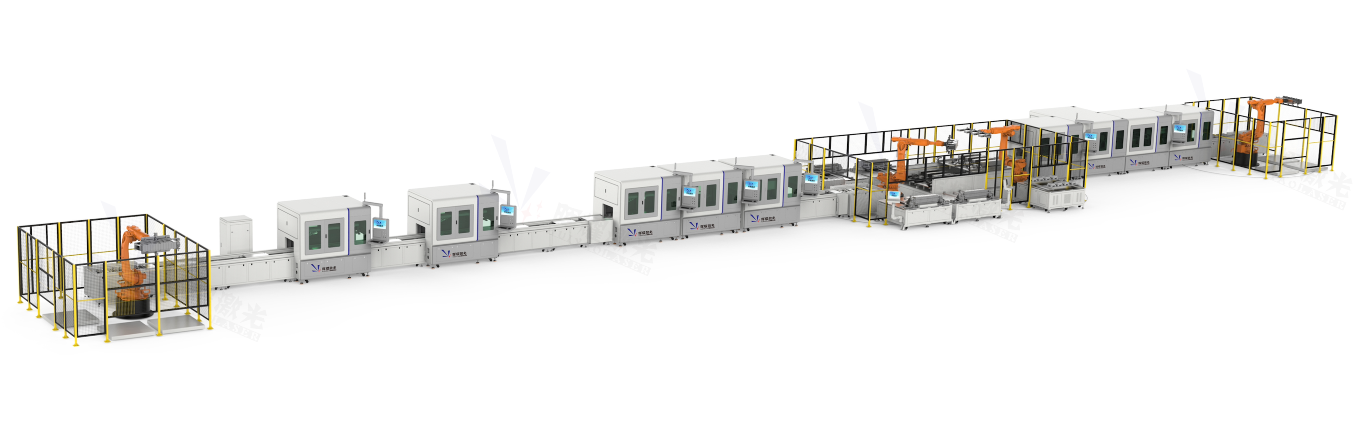
Prismatic Battery Module & Pack Assembly Line
Turnkey prismatic battery module/pack assembly line — fully or semi-automated, with ring-beam laser welding, IGOA operator assistance and North American compliance support.EnerLink Systems LLC · Fully & Semi-Automated
Questions answered
How can cell traceability be robustly maintained throughout the entire cell preparation and subsequent module assembly process?
Maintaining robust cell traceability throughout cell preparation and module assembly is crucial. This involves implementing systems that can uniquely identify each individual cell (e.g., via barcode, QR code, or RFID) and link it to its specific measured properties (like voltage, IR, capacity, grade from sorting) and its processing history. This detailed tracking must then follow the cell as it's integrated into a specific module, ensuring that every cell within a finished module can be traced back to its origins and characteristics. This comprehensive traceability is vital for quality control, performance analysis, warranty management, and efficient recall processes if any issues arise later.
How can incoming cell quality be rapidly, reliably, and comprehensively verified at scale to effectively detect and manage cells with both obvious and subtle defects, ensuring only high-quality cells proceed to assembly?
A critical challenge in cell preparation is establishing a robust system for verifying incoming cell quality at production scale. This involves not only rapidly checking for dimensional accuracy and obvious physical defects but also reliably identifying cells with more subtle internal defects through initial electrical state assessments. The goal is to implement efficient detection and rejection mechanisms that can safely handle and segregate any defective cells, thereby preventing their inclusion in modules and ensuring the overall quality, safety, and performance of the final battery product.
When will there be a system that can works flexibly with all cell format?
A key challenge and aspiration in battery module manufacturing is the development of production systems, particularly for automated cell handling and assembly, that can work flexibly with all major cell formats (cylindrical, prismatic, and pouch) and their various sub-sizes without requiring extensive and time-consuming retooling or separate dedicated lines. Currently, most automated equipment is optimised for a specific format or a narrow range of sizes. The industry seeks innovative solutions—perhaps involving advanced robotics with adaptable grippers, reconfigurable fixtures, and intelligent vision systems—that would allow manufacturers to quickly and cost-effectively switch between producing modules for different cell types on the same line. Achieving such universal format flexibility would significantly enhance manufacturing agility, reduce capital investment, and allow for faster responses to evolving battery designs and market demands.
What are the acceptance criteria — how is a good cell defined?
Acceptance criteria depend on each company's quality standard, but typical targets look like this: for NMC chemistries, a target delta OCV of ≤2 mV to ≤5 mV maximum variance across the batch; for LFP chemistries, ≤1 mV to ≤2 mV maximum variance. For internal resistance, a target delta IR of ≤10% total variance across the batch, with tier-1 premium programs aiming at ≤5%.
What happens to rejected cells — and how many should you expect?
Rejected cells are normally isolated and, according to your cell supply agreement, either sent back to the supplier or discarded according to the country's rules. How many depends on how tight the limits are: programs that limit acceptance to a 5 mV OCV variance — aerospace, for example — can end up discarding as much as 25% of a shipment. The testing is worth it: cells that are out of target produce unbalanced modules, and the BMS then works hard to compensate — inefficient over the long term.
Innovation & trends
Automated optical inspection (AOI) & AI:
High-resolution cameras paired with Artificial Intelligence (AI) are increasingly used to detect defects on incoming cells—such as dents, misalignment, or damaged insulation—before they enter assembly. These systems can operate at high speed, improving accuracy and reducing human error in early-stage quality control.
What are advanced cell sorting algorithms?
The use of more sophisticated algorithms, potentially incorporating machine learning, to optimise cell grouping based on multiple parameters and predict module performance. Vendors are now developing compact, all-in-one systems that handle cell loading, visual inspection, sorting, and alignment in a single automated station. These integrated modules reduce footprint, simplify logistics, and improve throughput for both small and large-scale operations.