Recycling Filter Press
Separates solids from metal-rich liquids after leaching in battery recycling for recovery and residue handling.
Key Takeaways
Solid-liquid separation technologies are required at various stages in the physical separation process (Physical Separation) as well as in the hydrometallurgical process (Hydrometallurgy). The choice of filtration method depends on process-specific factors like particle size, solid-to-liquid ratio, and the desired moisture content of the final solid.
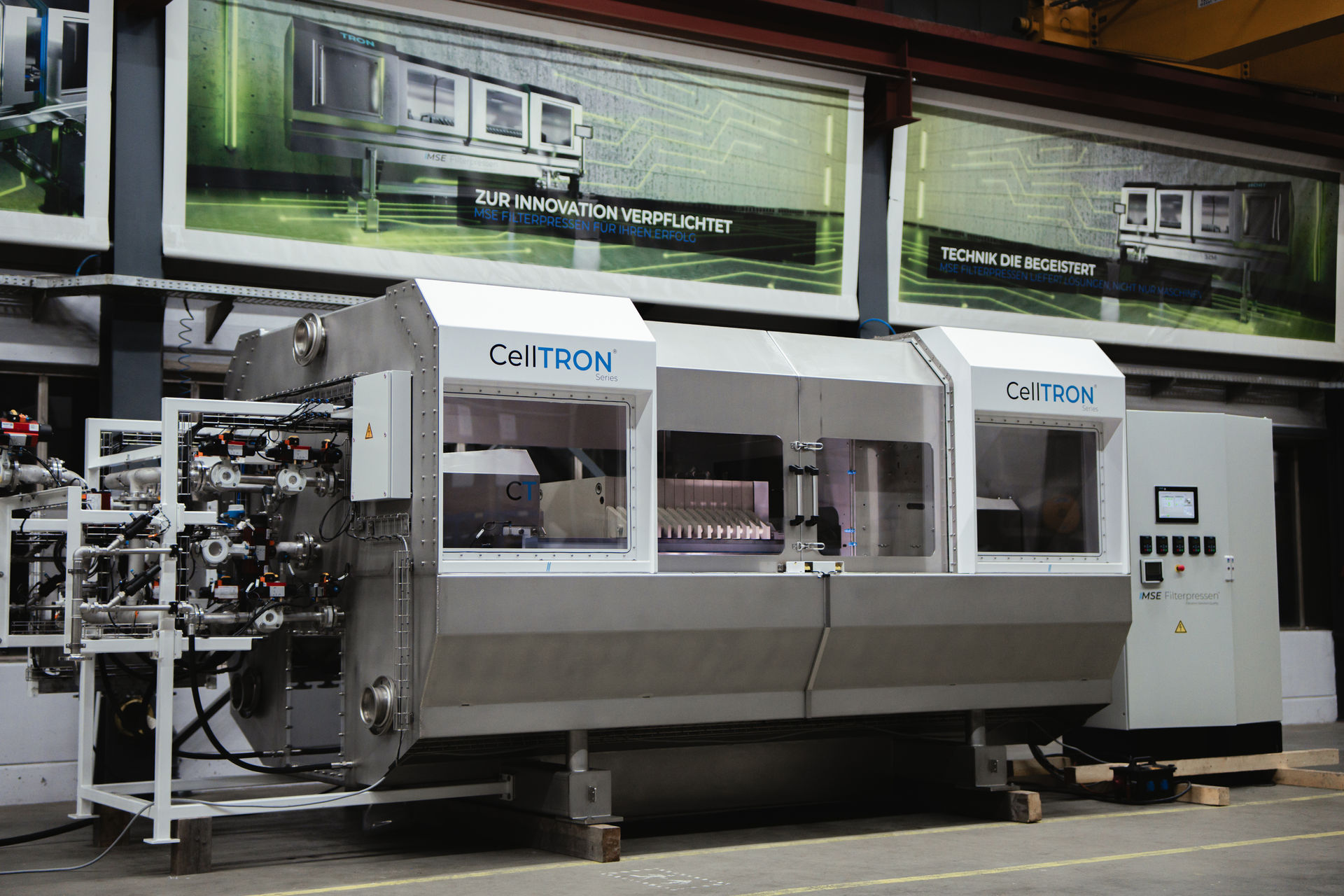
A filter press is commonly used to separate undissolved solids—such as black mass, graphite, plastics, or metal precipitates—from the liquid phase. It works by applying high pressure to push liquid through filter cloths mounted on a series of plates, while solids are retained as a compressed filter cake. The system typically includes a hydraulic unit to apply pressure, a feed pump to deliver the slurry, and mechanisms for filtrate collection and cake discharge. Automation modules can be integrated for improved efficiency and safety.
What to consider when choosing
What to think about when choosing a filter press
- Automation features such as automated plate shifting and filter cake discharge can significantly improve operational efficiency and reduce manual handling.
- Solid content in the slurry affects filter performance. Filter presses rely on cake formation—where solids form a dense layer that enhances filtration—so understanding the solids-to-liquid ratio is key.
- Particle size influences filter cloth selection. The cloth must be fine enough to retain particles but also allow for proper filtration without clogging.
What to look for in a filter press
A high-quality filter press must be resistant to corrosion, as it will come into contact with acidic solutions during the leaching as well as fluorinated compounds or electrolyte solvents during physical separation. It’s also important to ensure that the filtration capacity matches the processing throughput of your recycling line to avoid bottlenecks.
Solutions & suppliers
Verified solutions and the vendors behind them.
Filter Press is one piece of the recycling line
See where filter press fits into the end-to-end battery recycling process.
Back to the full guide →